

A major new R&A commissioned study by the International Institute for Golf Education, based at the University Centre Myerscough, has confirmed the huge potential female golfers offer to golf clubs.
“Many countries are seeing a fall in the number of both males and females playing golf and the research report analyses the factors which affect whole family participation in the sport, including women and girls, and details a number of useful practical recommendations for national golf bodies and golf clubs to help them encourage more women and girls to play,” said a spokesman for The R&A.
“A significant growth opportunity exists for golf if it can attract more women, girls and families into playing the sport more often.”
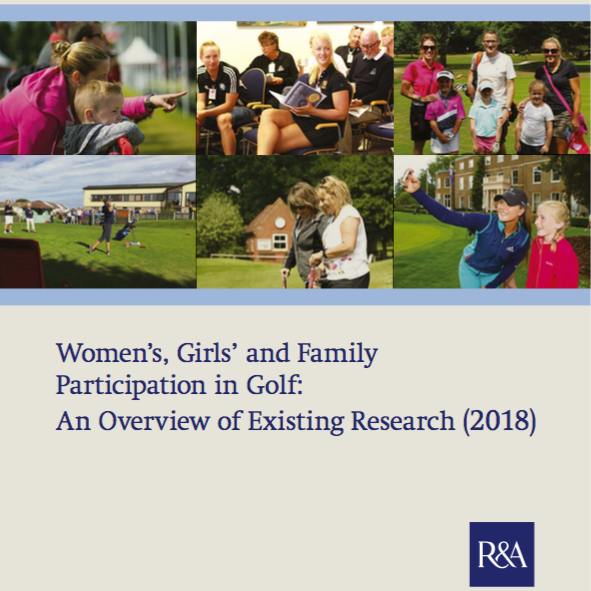
The key themes identified in Women’s, Girls’, and Family Participation in Golf: An Overview of Existing Research (2018), which brings together the findings of existing academic and industry research with the individual views of a wide-ranging group of golf experts, and was produced by Dr John Fry and Philip Hall, include:
- The importance of establishing the optimum environment for family participation by being aware of the make-up of the modern family
- A direct link between equality in sports participation and wider measures of gender equality such as women in influential decision-making positions in golf
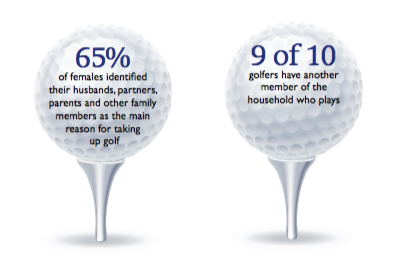
- That parents are the chief factor underpinning families’ likelihood to play golf and that their motivations for their children taking part include having fun, improving health and developing friendships
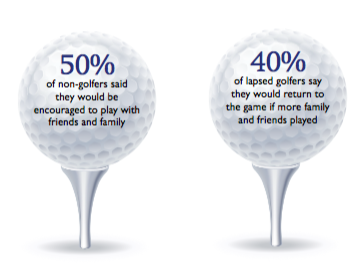
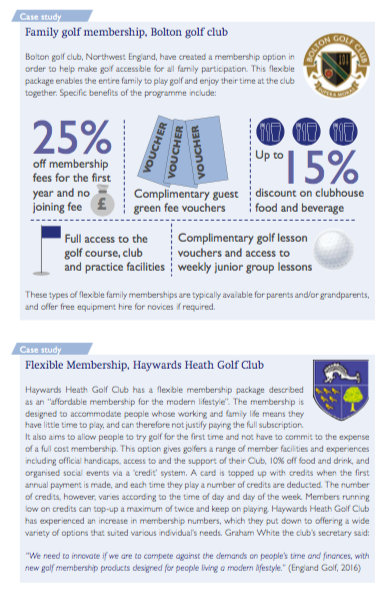
- The increasing desire for golf to provide opportunities for socialising and to be adaptable and flexible given the time and cost constraints placed on the modern family
- The need for the sport to evolve to meet the demands of contemporary society and for clubs to encourage memorable events for their customers, as that memory itself or the ‘experience’, is increasingly replacing the ‘product’ of playing golf.

‘A legacy of traditional perceptions of a ‘stereotypical’ golfer still exists – typically older middle class white males,’ states the report.
‘The golf industry should look to challenge these perceptions through developments, such as dress codes and by offering a range of activities for family golfers.
‘The spatial layout of golf courses can impact on enjoyment levels amongst beginner golfers. Many women and juniors experience ‘statistical discrimination’, where an individual stereotype becomes misapplied to the group, and they are treated as if they possess those qualities and characteristics, regardless of their individual abilities. Adopting course types and set up appropriate for the playing standard of the golfer can help reduce difficulties and frustrations for family participation.
‘Changes in the golf industry are often subject to resistance from various groups, which may be detrimental to long term participation. There is a balance to be achieved between providing for the established members, that have been loyal to the club over multiple years, and new members who may move from club to club. Greater awareness and focus on a club’s target market is important in this regard.
‘Golf should look to encourage memorable events for their customers, as that memory itself, or the ‘experience’, is starting to becomes the product. Consumers are now more likely to wear experiences as ‘badges of honour’, indicating that there is greater value in what one can achieve, as opposed to what one can possess. Golf clubs are advised to consider their unique story based around their history and traditions.
‘Research indicates that family friendly leisure facilities should include priority parking, provision of an affordable and available crèche to encourage families with younger children, ‘play areas’ within the facility enabling children to engage in informal play within sight of their parents. ‘Alternative’ leisure programmes aimed at engaging families could also include activities for parents and guardians, family-based classes and / tuition, family open days, and reductions on fees / subsidised passes for families. Research has also shown importance placed on the quality of facilities, such as on course toilets and drinking water.’
Dr John Fry said: “The report brings together for the first time in one place the key academic and industry research articles conducted on family sports participation.
“The process involved searching scientific databases containing more than one million citations, peer-reviewed research papers and selecting the most appropriate evidence based studies that can help underpin strategies to increase participation in golf.
“The research is supplemented with case studies of best practice, analysis from a number of industry experts and offers a series of practical actions which golf clubs can adopt.”
Martin Slumbers, chief executive of The R&A, said: “The research demonstrates there is a tremendous opportunity for golf to grow its participation numbers and generate more income if it can attract more women, girls and families into playing the sport.
“We know that more work needs to be done to achieve this outcome at a time when there are concerns about declining participation levels and this report provides useful actions and guidance for our affiliates and clubs that can lead to tangible, positive outcomes for golf.”
The full report can be accessed here: https://www.dropbox.com/sh/7l2f2xnrolihnus/AACv1KWhCwzSAL66OME3qEL5a?dl=


Leave a Reply to Philip Cancel reply