

Does leaving the flag in the hole increase the chance of the golf ball not dropping? By Tim Webb, Tacit.
An ongoing hot topic in the industry is the rule changes introduced by The R&A and the USGA a few years ago with reference to the ability for golfers to leave the pin in situ while putting.
Recently I received a slightly concerned email from a very well-known superintendent on a very prestigious Florida course. We had a meeting, but as he put it “the talk of the town” (or at least his club and his greens chairman) was the pin in the cup.
And more to the point, if they were going leave the pin in the cup, which style of pin should they leave in? What were the advantages or disadvantages of the different pins?
Now it may come as a shock to most golfers but regarding the pins and specifically the diameter of the pin in the critical 100mm area on the flag pin, there are at least eight different versions that Tacit alone makes.
They are:
- 1/2 inch plain
- 1/2 inch with one PVC sleeve
- 1/2 inch with two PVC sleeves
- 5/8 inch plain
- 5/8 inch with one PVC sleeve
- 5/8 inch with two PVC sleeves
- Javelin pin with one PVC sleeve
- Javelin pin with two PVC sleeves
At this point I am much better at working in metric, so both the 1/2 inch pin and the javelin pin at the point where the ball enters the hole are 12.5 mm in diameter unsleeved.
Every time we add on a piece of PVC sleeve, we increase the diameter by approximately 2mm.
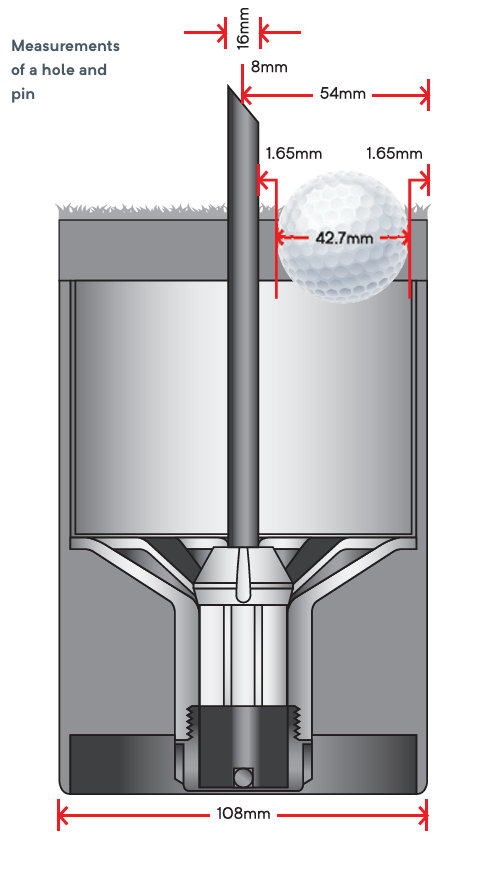
A javelin pin with two sleeves being equal to 16mm in diameter is the pin that the course I was meeting would be using. Incidentally, that’s the one used at the Old Course in St Andrews.
A golf hole is 108mm wide, while a golf ball is 42.7mm. So, if we take one side of a hole (54mm) and minus one side of our largest flag pin (8mm) and the size of the ball (42.7mm), we are left with 3.3mm clearance for the ball to enter the hole.
That is less than 2mm on either side of the ball, provided the hole is accurately cut to 108mm and the pin is vertical. This is something I will return to later.
I would regard myself as somewhat of an expert on cups and pins, but the question of “which pin would provide the best option for a golfer?” had me guessing.
I grabbed a range of pins that were immediately to hand (1/2 inch plain, 1/2 inch with one sleeve, javelin with one sleeve, javelin with two sleeves), a sleeve of Titleist Pro V’s and a stimpmeter to give a consistent velocity when the ball hits the pin.
I dashed to my local club who, kindly, gave me permission to roll balls around their first green for as long as I wanted. The green was stimping at 9 feet, so I thought a good starting point would be 6 feet away from the hole. I then rolled the balls at the centre of the hole with each of the pins in situ and with no pin at all.
I then repeated the exercise at 5 feet, 4 feet, 3 feet and 2 feet. I stopped at 2 feet as a putt of this velocity from this distance, if missing the hole, would end up around 7 feet past the hole. I did three rolls at each pin at each distance and two hours later, with darkness encroaching, I had my result, proven by science.
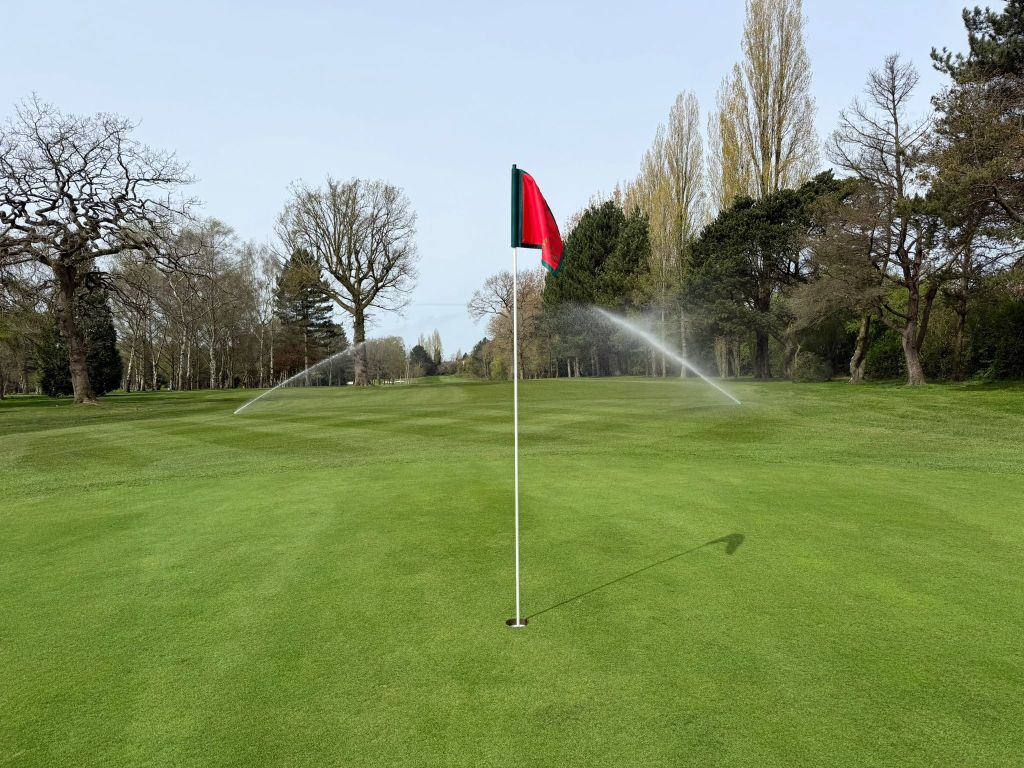
There was absolutely no difference as to which pin was in the hole or if there was no pin at all. All rolls going to the centre of the hole went in until we got to 2 feet. At which point the only pin to behave differently was the 1/2-inch pin unsleeved, where two of the rolls bounced away.
I will leave it to you to draw your own conclusions from this exercise, but for me it just reinforced that in order to get the ball in the hole all you need to do is putt it into the middle of the hole, regardless of which pin is in the hole or if there is no pin at all.
However, if you do decide to leave the pin in, there are two very crucial factors involved.
Firstly, the hole must be accurately cut to 108mm (4¼ inches). An auger holecutter cannot achieve this, while a twin-bladed hole cutter struggles. The Tacit Shole holecutter has proved worldwide to be the holecutter that can provide that accurate cut and maintain its shape. The same hole cutter that is used at St Andrews and will be used at Royal Birkdale for the Open this Summer.
Secondly, the pin needs to be held bolt upright. Again, Tacit’s ferrule and cup combination with the subcap configuration is the only holecup that holds the ferrule in two separate places, thus maintaining that all-important vertical position and keeping that position day after day, giving the correct tolerance to allow the ball to drop unhindered into the hole.


Leave a Reply