

BBC Radio 4 has devoted a 30-minute programme to analysing the state of the UK’s golf industry after nearly 20 years of significant change.
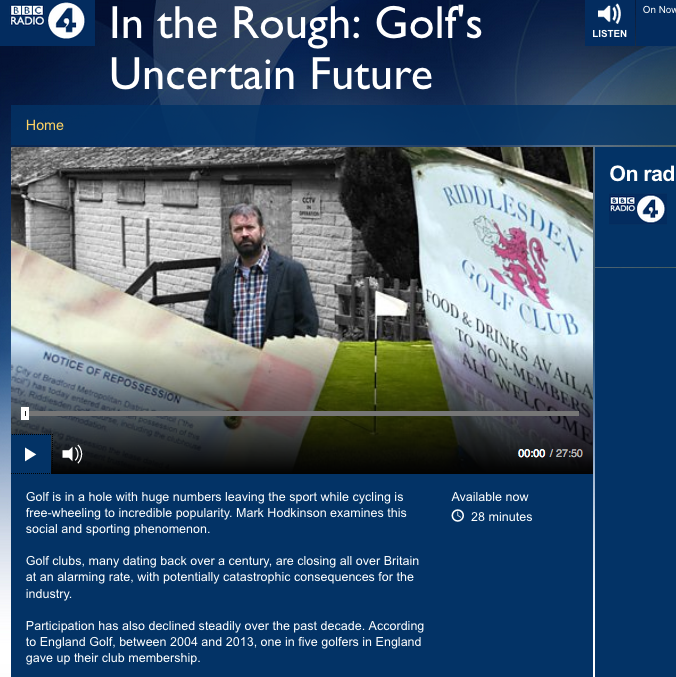
Journalist and broadcaster Mark Hodkinson visited Riddlesden Golf Club in Yorkshire, which closed down last year, and talked about the changes – including the rise of cycling – with the likes of The Times’ former golf correspondent John Hopkins, the BBC’s golf correspondent Iain Carter and the editor of The Golf Business, Alistair Dunsmuir.
“In the 1970s and 80s many men of a certain age and class spent their weekends and summer evenings playing golf,” stated Hodkinson. “Not any more. England Golf reports that one in five golfers has given up club membership since 2004.”
The programme then revealed that over a recent seven-year period the number playing once a month has fallen from 1.5 million to 1.1 million.
“It has had the knock-on effect of hitting golf clubs very hard, leading to many closures,” said Dunsmuir.
Riddlesden Golf Club was formed in 1927, its membership halved over three years to barely 100, forcing it to close last year. It is now abandoned, the greens overgrown, the clubhouse derelict and boarded up.
“When the council came and took the keys off me, the drive home that day was gutting,” John Dickinson, its former secretary, who had played the course for more than 30 years, revealed. “My wife just said to me, ‘Sit down, I’ll get you a drink, because I know how you feel’.”
The broadcast explained that gender roles and the work / life balance in society may have played a role in the participation decline, as men are now less likely to disappear for a day to play the game.
“People are working longer hours and want to better enjoy their free time,” said Professor Sir Cary Cooper of the University of Manchester, an expert on wellbeing. “Studies have shown that the key to this is relationships, especially within the family. So this means men aren’t out on a golf course somewhere with their mates but are doing stuff with their wife and kids.”
Richard Fletcher, business editor of The Times, told the programme that he believes cycling has replaced golf as an out-of-office jolly, where contacts are made and business deals negotiated.
“I can’t remember when I was last invited to a golf day,” he said. “So many people now cycle and it has a real corporate element. Often it will be the first topic discussed, or we’ll agree to follow each other on Strava [a website and mobile app that tracks athletic activity via GPS].”
The programme did leave cause for optimism however.
“Whatever the doomsayers say, it is still the fifth most popular sport in the UK,” said Hodkinson.
“Whether you’re playing traditional golf on a great course, or at your local municipal, or TopGolf, or on the driving range, you’re contributing to the industry,” said Carter. “All these different initiatives give me optimism that golf can grow and remain relevant. And golf will be massive at the next Olympics in Tokyo.
“But golf has to find ways of playing it to make it more attractive to families; to women and children.”
In The Rough: Golf’s Uncertain Future was broadcast on Monday, July 3 at 8pm and Wednesday, July 5 at 11am. You can hear the broadcast online here:
http://www.bbc.co.uk/programmes/b08wn9mj


Leave a Reply