

A new report in the Sunday Times states that two-ball golf will return in England in late March.
This corresponds with an article that appeared recently in its sister paper The Times, that says that Boris Johnson will announce on February 22 a roadmap to reopening the country, which will see golf courses return to operation in the first wave after schools reopen on March 8.
The latest report goes slightly further, and implies that two-ball golf will return to England in time for the new golfing season at the end of March.
‘A second easing of social distancing rules is expected at the end of next month with the resumption of outdoor sports – such as golf and tennis – two people from different households,’ reports the newspaper.
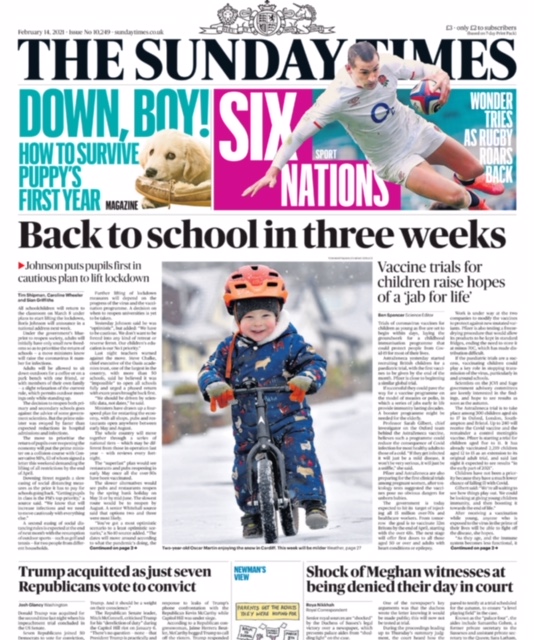
‘Ministers have drawn a four-speed plan for restarting the economy, with all shops, pubs and restaurants open anywhere between early May and August.
‘The whole country will move together through a series of national tiers – which may be different from those in operation last year – with reviews every fortnight.’
English golf courses have been in full lockdown since early January – and golf courses in Wales, Northern Ireland and the Republic of Ireland have been closed since December. Golf is currently permitted in Scotland, but only under restrictions.
Recent research has found that the ‘level of [Covid-19] transmission from playing golf is likely to be extremely low’ and has led to calls that an expert in physical activity joins the UK’s SAGE advisory group.
This comes as new research finds that the chance of being infected with Covid while outdoors is ‘massively reduced’.
Furthermore, scientists have found that the risks are particularly low in fully open spaces such as golf courses.
Researchers found that fresh air disperses and dilutes the virus, and it helps to evaporate the liquid droplets in which it is carried.
On top of that, ultraviolet light from the sun should kill any virus that’s out in the open.
Even so, there are a handful of cases where it’s believed that infections did happen outside.
One study found that two men in China talking face-to-face for at least 15 minutes was enough to spread the virus – so the advice is to avoid being face-to-face if you’re outside with somebody else and less than two metres apart.
As for the virus being on outdoor surfaces such as flagpoles, researchers in the US found the virus on the handles of rubbish bins and the buttons at pedestrian crossings.
They reckon this may have led to infections in the area, though at a relatively low level compared with other ways of spreading the virus.
Many scientists now think that the amount of virus likely to be left on a surface would be minimal, and would disperse within an hour or two.
“The chance of transmission through inanimate surfaces [outdoors] is very small,” says Prof Emmanuel Goldman of Rutgers University.


Leave a Reply to Gabriel Ice Cancel reply