

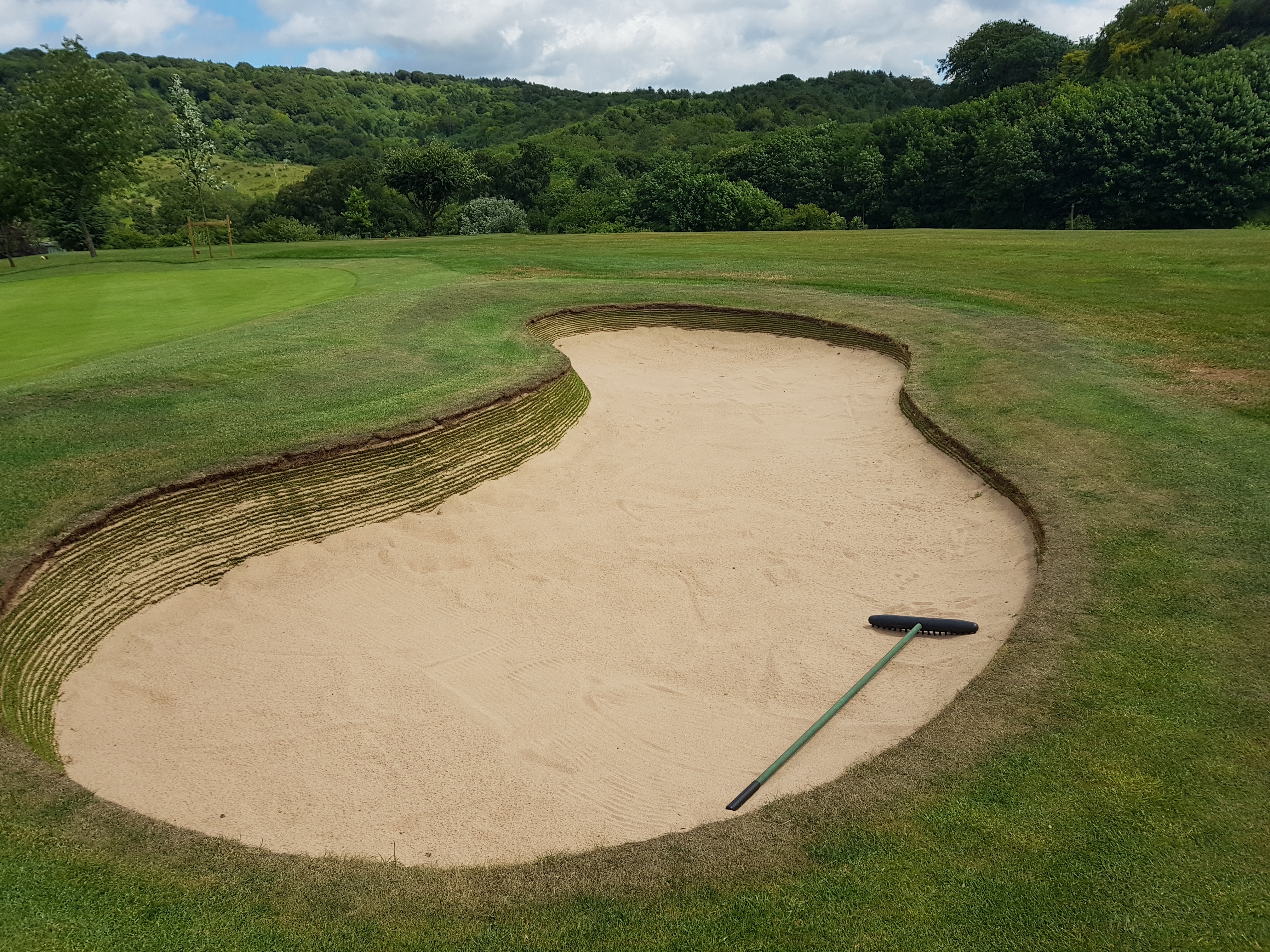
Here we will review three frequently asked questions pertaining to bunkers.
Greens’ staff often use the winter months to carry out renovation works on bunkers which can mean that some are still recovering at the start of the spring season. The R&A is often asked how to take relief from a bunker that has been recently renovated and marked as ground under repair (GUR).
Previously, committees used to have to classify the bunker as GUR ‘through the green’ within the local rule to remove the bunker’s hazard status. But, as of January 1, 2010, the position was reversed and clarified by a revision to decision 25/13. Currently, by default, if the entire bunker is defined as GUR, it loses its status as a hazard, unless otherwise stipulated by the committee.
Consequently, Rule 25-1b(i) applies when there is interference from the GUR as the ball is considered to lie through the green for relief purposes. Under this rule, the player must lift the ball and drop it, without penalty, within one club-length of, and not nearer the hole, than the nearest point of relief.
It is a common misconception that it is compulsory for the player to play back over the hazard when taking relief and dropping outwith the hazard. Actually, there is no option under Rule 25-1b(i) to drop the ball behind the point where it originally lay, keeping that point directly between the hole and the spot on which it is to be dropped. The key is to find the nearest point of relief, which may be to the side or behind the bunker, depending on the ball’s original position.
Relief is optional under Rule 25-1b(i), so if the committee in charge wishes to protect the bunker and allow it time to repair free from play, it must stipulate in the local rules that the bunker is ground under repair from which play is prohibited. As a result of prohibiting play from the GUR, the player must take relief when he has interference.
It is worth noting that there is a difference between a bunker that is being renovated and one that is simply flooded. In terms of flooded bunkers, the committee may not make a general local rule providing that flooded bunkers are ground under repair. Such a local rule waives a penalty imposed by the Rules of Golf and would be contrary to rule 33-8.
What can a committee do when a bunker is flooded?
Where conditions are such that certain bunkers are completely flooded prior to a competition starting and there would be no opportunity for the condition to improve during the competition, the committee may introduce a local rule providing that these particular bunkers are ground under repair.
This again automatically takes away the status of the hazard (they then become ‘through the green’) and allows for relief to be taken without penalty in accordance with Rule 25-1b(i). The key to this local rule is that the bunker must be completely flooded to merit such a status and it should specify exactly which bunkers that the local rule applies to – and not just any bunker containing some water or water damage.
For example, a local rule might read: ‘The flooded bunker on [insert the location of the bunker, for example, left of the 12th green] is GUR. If a player’s ball lies in the bunker or the bunker interferes with the player’s stance or the area of his intended swing, the player may take relief outside the bunker, without penalty, in accordance with Rule 25-1b(i). All other bunkers on the course, regardless of whether they contain water, maintain their status as hazards and the rules apply accordingly.’
If only part of the bunker is flooded or only part of the bunker merits marking as GUR, then the rules contemplate relief from these situations under Rule 25-1b(ii).
Finally, The R&A is often asked as to our views on where to position bunker rakes. In fact, there is no hard and fast rule.
In practice, players who leave rakes in bunkers frequently leave them at the side or at the back of the bunker where it is easy to place the rake. This tends to stop a ball rolling into the flatter part of the bunker, resulting in a much more difficult shot than would otherwise have been the case. This is especially the case when bunkers are small.
If rakes are left in the middle of the bunker, the only way to position them is to throw them into the bunker and this causes damage to the surface. If it is a large bunker, the player usually walks into the bunker to remove the rake prior to playing a stroke and then must rake all of this area as well as the area where the stroke was made, resulting in unnecessary delay.
Therefore, whilst it can be argued that a ball could be deflected into the bunker when the rake is placed outside of it, considering all these aspects, it is recommended that rakes should be left outside of the bunkers in areas where they are least likely to affect the movement of the ball. This is just a recommendation and ultimately it is for the committee to decide where it wishes the rakes to be placed in the best interests of the course.
Shona McRae is manager of the Rules of Golf at The R&A


Leave a Reply to Doug Cancel reply