

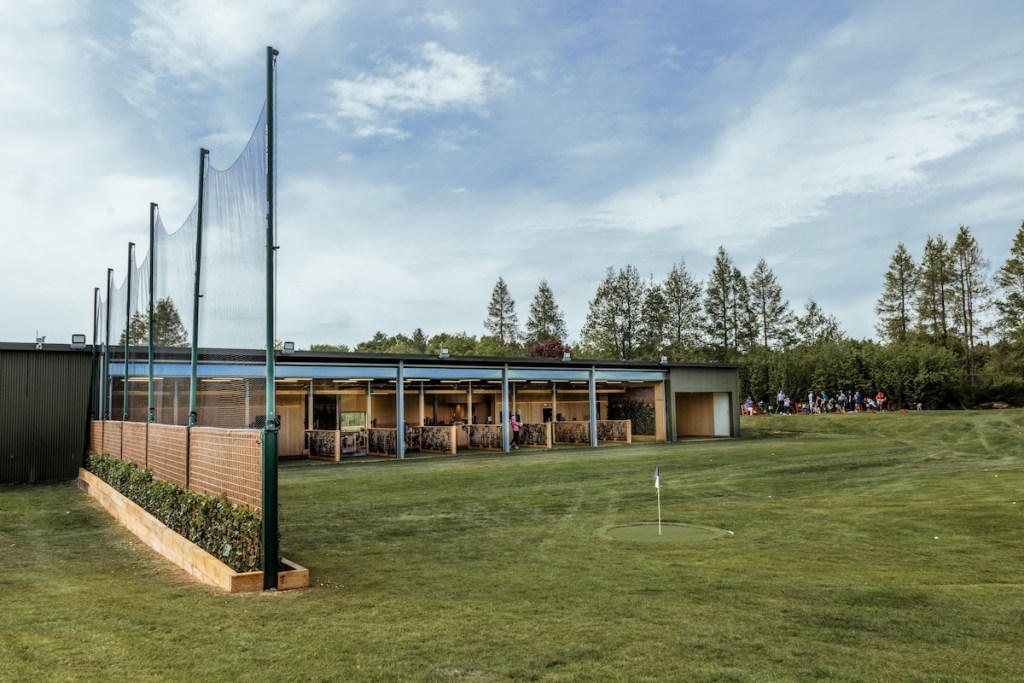
The 1907 Academy at Basingstoke Golf Club has raised the bar among the most environmentally progressive golf academy buildings ever delivered, combining carbon-sequestering natural materials, advanced sports performance technology and low-impact construction methods in a pioneering project designed to challenge conventional thinking around golf facility development.
Delivered as part of the club’s wider £20 million transformation, the 1907 Academy has been developed in partnership with SYNLawn UK and Build With Hemp to demonstrate how elite-level golf infrastructure can be designed around measurable environmental performance without compromising functionality, aesthetics and commercial viability.
The project incorporates natural and living materials including hempcrete structural fill, responsibly sourced English oak timber, hempfiber batt insulation and an ivy and honeysuckle living wall. Together these core structural and interior elements actively contribute to carbon reduction, with sequestration benefits compounding over the building’s lifetime as the living wall matures.
Sustainability analysis highlights the project sequestering an estimated 2,705kg of CO₂e at completion with projected sequestration rising to approximately 7,705kg of CO₂e as the panels mature.
This is equivalent to offsetting approximately 14,900 miles of petrol vehicle travel, 17 return flights from London to Edinburgh or the annual carbon absorption of around 270 old growth trees per year.
Rather than treating performance and environmental responsibility as competing priorities, the 1907 Academy has been engineered to combine both. The academy’s coaching and practice environments use advanced SYNLawn golf systems developed to replicate the bounce, check, roll and ball response of natural golf surfaces while dramatically reducing water consumption, fertiliser dependency, mowing requirements and ongoing maintenance inputs associated with traditional practice facilities.
The installation includes SYNLawn Tee Strike and Tee Strike+ hitting systems, Precision Putting technology and short-game surfaces designed to deliver year-round consistency for coaching and player development. The same technology platform is used by TGL, the technology-led golf league created by Tiger Woods and Rory McIlroy, where SYNLawn serves as the Official Synthetic Surface Partner.
Sustainability runs through SYNLawn UK, from the manufacturing facility being carbon neutral and powered entirely by renewable energy to utilising post-consumer recycled waste such as plastic bottles and eliminating single-use plastics, pioneering bio-based materials and fully recyclable products.
The 11 covered bays, including a double coaching bay, and five open-air hitting bays, include Trackman state-of-the-art technology, capturing detailed shot data including launch angle, spin rates, ball speed and carry distance.
These technologies have been integrated into a wider low-carbon construction strategy.
The building uses natural hemp materials throughout its structure and internal finishes, including acoustic panelling, insulation systems, bay dividers and range barriers. Hemp shiv resin-bound pathways, recycled English oak detailing and rainwater-fed living walls further reinforce the environmental design strategy while also improving thermal regulation, acoustics and long-term durability.
Michael Walker, CEO of SYNLawn UK, said: “The 1907 Academy proves that the future of golf construction does not have to follow the traditional model of high embodied carbon and resource-intensive operation. This project demonstrates that elite performance environments can be delivered through intelligent material selection, low-impact construction and advanced engineered systems working together.
“This is far more than a practice facility. It is a statement about where the golf industry can go next. Every part of the academy has been designed to challenge assumptions around sustainability, performance and long-term operational efficiency. We believe it establishes one of the clearest examples yet of how golf infrastructure can evolve responsibly without sacrificing quality or ambition.”
David Green, general manager at Basingstoke Golf Club, said: “From the beginning, the ambition was to create a facility that stood apart from conventional academy design. Sustainability was not treated as an add-on or a marketing exercise. It informed the materials, the engineering, the operational model and the overall user experience.
“The result is a building that performs exceptionally well for coaching and practice while also delivering measurable environmental value. We believe the 1907 Academy sets a new standard for what modern golf facilities should aspire to become.”
More than five tonnes of carbon-storing hemp-based materials have been built directly into the academy through hempcrete walls and 193m² of natural hemp insulation – turning the building itself into a long-term carbon negative building. Combined with more than three tonnes of sustainably sourced oak timber and an 80m² living wall planted with ivy and honeysuckle, the academy has been designed to work with nature, actively reducing environmental impact while supporting biodiversity and creating a healthier, more sustainable space for future generations.
As golf clubs and developers increasingly face pressure to reduce environmental impact and demonstrate credible sustainability outcomes, the 1907 Academy is expected to become an influential reference point for future golf infrastructure projects globally.


Leave a Reply